


The Turner Ink blog contains rants, bloopers, observations and opinions. It also has handy tips on grammar and punctuation such as colons: semicolons; and full stops. As well as some very useful ‘how tos’. Feel free to leave comments. Be nice though.

Turner Ink

Copywriting Services London

Posts tagged 'seo'

The Periodic Table of SEO Ranking Factors

18th
Nov
by Sarah Turner

The guys over at Search Engine Land sure do great infographics. This has been stuck to my wall for a while now and I’ve sent it to a few clients in the last month. Thought it would be good to share on the blog. Check it out. And get your own copy here.


New website? Start at the bottom and work your way up

17th
Nov
by Sarah Turner

So you’re having a house built. It’s a superb design. A grand design in fact. And yes. It is the same house from yesterday.

But this time the walls have gone up, the windows have gone in and the roof has gone on. And it’s looking mighty fine. But wait. What’s this? There’s no foundation? No problem, you say. We’ll put that in at a later date. Maybe next month. Or later on in the year.

Can you imagine what a pain that would be? To try and install a foundation under your house once it has been built? Not impossible. But not easy. And completely arse about face.

Building a website without thinking about SEO is like building a house without a foundation.

Keyword research reveals which keyphrases are actually being used when people – potential customers – are looking for your products or services. From the keyword research we decide what pages your site needs and the content of each page. Then you get a brilliant copywriter to write optimised copy, with the keywords cleverly weaved throughout so your visitor doesn’t notice them but the search engines do. And then your developer and designer come on board, once they know how many pages there are and how much copy there is.

SEO, like a foundation, underpins your website. It should be the first thing you think about not the last. Don’t be tempted to get your website up as quickly as possible and then consider SEO. It’s not impossible to optimise a site once it’s live. But it’s not easy. And it’s completely arse about face.

Find out more about SEO copywriting or get in touch.

Image courtesy of terren in Virginia


Let’s get digital. An interview with Matt Sawyer of Datadial

22nd
Jul
by Sarah Turner

This month, I’ve managed to grab a few moments with digital marketing expert Matt Sawyer (who was one of the first industry bods I ever followed on Twitter). Matt heads up the online marketing department over at digital agency Datadial. We talked about link campaigns, the best blogs to read and why is the SEO industry coming in for some flak?

Turner Ink: You’ve been head of SEO and digital marketing at Datadial for five years now Matt. What’s changed in the industry since you joined?
Matt Sawyer: Everything and nothing. I see a lot of talk about how SEO is constantly changing, but really the fundamentals have remained the same – good content in a well organised and well structured website.

Social media has really changed link development though, and it’s forced SEOs to think a lot more creatively about who will link to them and why.

TI: So where is the SEO industry heading? What’s it going to look like in 5 years’ time?
MS: I think we’re going to be a lot more integrated with other marketing disciplines. To a lot of people we’re always the geeks in the room at the end of the corridor that nobody really understands. I think the industry itself is partly to blame for that.

Over the last couple of years though, SEOs have become far more closely integrated with development, sales, marketing and editorial teams and we’re doing a much better job of educating people, not just on what we do and why we do it, but also how it complements their roles.

TI: That’s interesting. Because there’s been a bit of SEO bashing online lately. (This is the post that springs to mind.) What are your thoughts?
MS: I completely understand why people feel that way when so many people have had bad experiences with SEOs. I think there is a real knowledge gap between the marketing managers and SMB owners that are buying-in the services and the companies that are selling them. Unfortunately, this either leads to companies taking advantage of this, or services being mis-sold.

TI: Ok Matt, how do you execute an SEO strategy? What do you do specifically?
MS: Generally for us it falls into four distinct stages:
1. Site architecture – ensuring the site is technically correct. Everything from making sure all the pages are reachable by search engines, to checking for duplicate content issues.
2. Site structure – checking that the site is organised logically, with relevant category pages.
3. Keyword research and page optimisation.
4. Link building and social media strategy.

TI: Yes, links are a major factor in the success of a site’s SERPS positioning aren’t they? How easy or difficult is it to get quality links?
MS: Links are THE biggest factor in rankings for competitive phrases. Getting good quality links is easy. Getting them in large enough quantities is harder. Social media has made the process easier and more scaleable, but you still have to rely on great ideas to make things work.

TI: I’ve locked horns with a number of so-called SEO experts who are more concerned with the mechanics of SEO and don’t give a hoot about the quality of the writing. What are your thoughts?
MS: Always write for users. There’s no point getting visitors to a page if it looks like it’s been written by a 5 year old (or me for that matter). There is no reason why a page can’t be optimised as well as written with conversions in mind.

TI: Well, I totally agree with that! What SEO tools do you use?
MS: I think most people would be surprised how few tools SEOs really use. I think there’s a misconception that we automate everything. But really the only tools we use are those that speed-up fairly menial tasks or give us more metrics to play with in Excel.

For example we use a ranking checker to monitor site rankings changes. I also use the Open Site Explorer to pull link data and site metrics into Excel. Majestic should also get an honourable mention here. I also like using Xenu which can spider an entire site, extract page metrics and export all of the data to a .csv file.

TI: Do you only optimise for Google?
MS: Realistically, yes. In the UK, especially, they have such an obscene share of the search market that they have to be the search engine that’s at the forefront of your strategy. However, most search engines work in similar ways, so you’ll find that most SEO work brings similar benefits on all search engines.

TI: But is Bing becoming more important?
MS: Slowly. I’m seeing its search share gradually start to creep up, and before long Yahoo will start to serve Bing results.

TI: What other services do you offer at Datadial?
MS: We’re a full service agency. So we do everything from design, development and hosting, through to digital marketing, email marketing and ebusiness consultancy.

TI: I know you handle online PR and reputation management for clients as well and you’ve developed an in-house reputation monitoring tool. Tell us how that works.
MS: Our reputation monitoring tool works by pulling together lots of different data sources – such as Google (news and blogs), Twitter mentions, RSS feeds and several others, which it then parses for mentions of the client name. These are then displayed in an admin control panel. A lot of similar services tend to over-complicate things, so we have tried to go the other way and keep thing as simple as possible for the user while retaining functionality.

TI: You and I are both on Twitter quite a bit. Are you finding clients want to jump on the social media bandwagon no matter what their product or service?
MS: A lot of people seem to decide that they want to do social media before they have thought about why they’re doing it and what they want to get out of it. Some companies are made for social media; others need to think about culture change before they engage in social media.

The key thing to remember is that consumers aren’t always the best group for your company to try to engage with. Often, it’s better to network online with the bloggers and journalists in your industry.

TI: Talking of bloggers – you write for the Datadial blog Matt. And, of course, you write for own blog. What topics do you cover?
MS: With the Datadial blog we write primarily for our clients, on (hopefully) interesting topics and issues that affect them and their business.

My own blog has actually been around for several years in one form or another, and I tend to use it to organise my own thoughts and rants more than anything else. I have been known to post at 3am when I have ideas that I need to get down somewhere!

TI: I hate to think what I’d blog at 3am! What other blogs do you read or recommend?
MS: The SEOMoz blog is fantastic, both for advanced SEOs and novices alike. The range of topics covered and the resources that they have available really are second to none.

Other than that I regularly read (and recommend) EConsultancy, SEOptimise, Apple Pie And Custard (who also win the prize for the strangest name), Search Engine Land, Malcolm Coles and SEO By The Sea.

TI: And last question Matt. What does a normal day look like for you?
MS: Normally I get into the office by seven. I cycle into West London from Surrey and spend around an hour reading my RSS feeds and answering emails. These days I tend to get more involved in the technical and strategic side of SEO, so that will include everything from site audits to planning structure and then organising the link and content development and social strategy. It seems I spend a lot more time at client meetings these days, so I’ll be out and about for much of the day.

TI: Thanks Matt. See you on Twitter.


Matt Sawyer - Head of SEO at DatadialMatt Sawyer is head of SEO and digital marketing at London-based digital agency Datadial and is considered one of the most influential SEOs in the UK.

He works with a wide range of clients and industries: from internationally recognized businesses to small, niche brands. His specialities include integrated digital marketing, SEO (on-page and off-page optimisation)

social media, digital PR, PPC, link development strategies and online marketing consulting.

On Twitter he describes himself as a social media junkie, part-time blogger, and full-time timewaster. Follow Matt on Twitter.


SEO FAQs (Infographic)

1st
Jun
by Sarah Turner

I was chatting to the guys over at digital agency Datadial last week when I casually mentioned the (rather fab) flowchart I’d recently created to show the relationship between Search Engine Marketing, Online PR and Social Media Marketing.

‘We did an infographic similar to that last month’ they told me.

Here it is. Take a look. It’s brilliant and way cooler than mine. I might have to give up ‘designing’ for good. Just click on it to enlarge it.
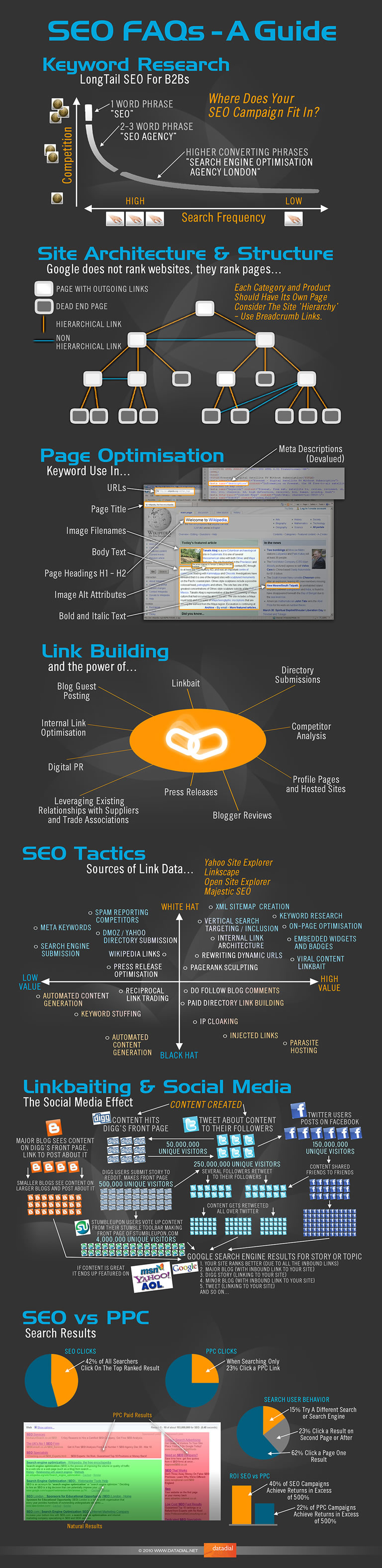
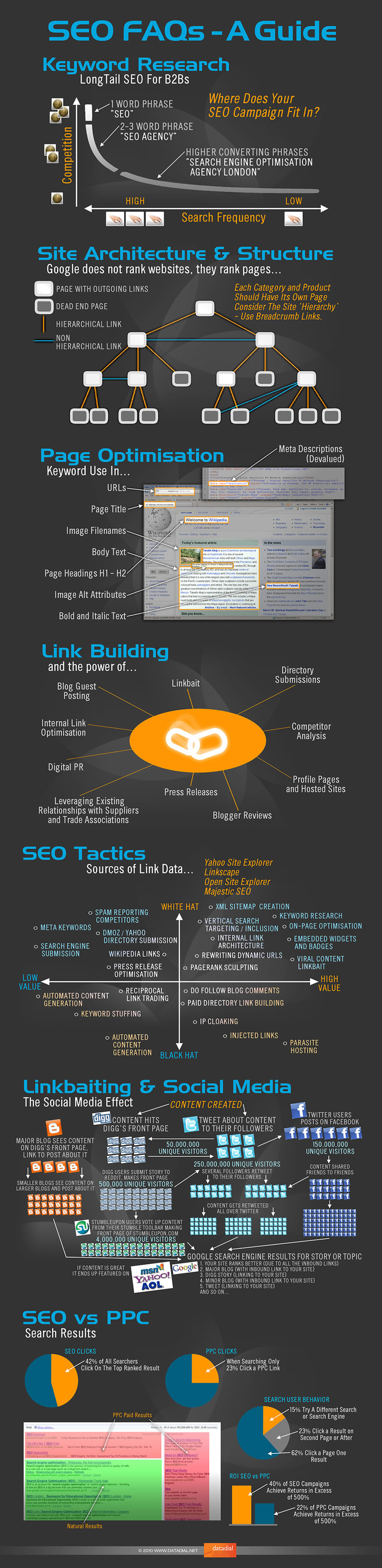
Datadial SEO Infographic

Copyright Datadial


Making it all Add up: An interview with Alison Blake

21st
Aug
by Sarah Turner

This month’s interview is with Alison Blake, marketing expert, and head of Add Agency, a creative marketing agency based in south west London.

Turner Ink: A few weeks ago I wrote a post about why companies shouldn’t cut their marketing budgets during economic downturns. Are you finding that’s the case Alison? Are companies increasing their spend? Or are they cutting back?

Add Agency: Well spend on printed materials has definitely been cut right back. I wouldn’t want to be a printer right now! But clients are still spending on marketing and much of it is going on online. Clients are realising that they really need an effective web presence, and a cost-effective way to stay in contact with their customers, like email newsletters, or they could risk losing out to their competitors.

TI: So are you doing more online marketing these days with PPC, SEO and email marketing?

AA: Yes definitely. Having an online ‘brochure’ style site is OK if you only expect people you know to refer to it occasionally. If you want customers you don’t know to find you on their own – by searching – then you need to work much harder. That’s where SEO and PPC comes into their own. Lots can be achieved through just SEO but if immediate results are needed then PPC is essential.

TI: What other services does Add Agency offer?

AA: We offer campaign planning, creative design and implementation for all forms of marketing communications. We design corporate identities, create websites, do SEO and online advertising. As well as email and printed newsletters, brochures, direct mail, catalogues and annual reports.

If you have something you need to say, we can work out the most cost effective and creative way of getting your message delivered to the right people

TI: So do clients have a clear idea of what kind of marketing they want when they come to you? Or do they tell you what they want to achieve and you tell them how to do it?

AA: Well most clients come to us with an idea of what they want and we can advise the best way to achieve it, usually through using a mixture of activities, from website updates to email marketing and even printed literature.

TI: What type of clients do you work with Alison?

AA: We work with a wide range of business to business and consumer clients. Understanding the different challenges facing each client is what keeps our day interesting!

TI: What’s your ideal client though? Apart from one with a huge budget?

AA: I guess our ideal client is a company that has been in business for 5 to 10 years. They have experienced rapid growth through the boom times and now need to focus on strengthening their marketing to allow them to continue to grow over the next few years.

They might have marketing expertise in-house, which is good, but not necessarily the design skills to implement their ideas.

TI: Does Add Agency have any particular area of expertise?

AA: Planning and developing testing strategies for direct marketing is actually my forte, but this includes integrated campaigns across all communication channels, i.e. mail, email, press, web and online ads.

TI: What does Add Agency offer that other marketing agencies don’t?

AA: Well our USP is the synergy of our combined skills together with our commitment to long-term relations. For us it’s not about a quick fix. But understanding and developing life time value from our clients. When that level of trust occurs between client and agency then you can really start noticing the results.

TI: What’s been your most successful campaign to date?

AA: That’s a hard one to choose. There’s been a few. But I suppose my favourite would be winning a DMA Gold Award for an internal communications campaign for Royal Mail. On a relatively small budget we had to convince postal workers that Mailsort 3 mail was also important and should be sorted quickly.

It was about taking a technical issue and relating it to individuals on a personal level, so they could see the impact the activity had upon others. We used a mixture of creative workplace posters as well direct mail. And as a result of the campaign we improved service by about 28%.

My job is all about understanding client problems and identifying what needs to be achieved. I then have to bring out the best in the creative teams, so they can deliver imaginative and outstanding campaigns for our clients.

I also remember my worst campaign quite clearly. We launched a unit trust for Commercial Union on Black Monday 1987 when the worldwide stock markets crashed. We didn’t even recoup the £7m marketing costs!
I learnt that timing can have a far more major effect on results than any creative message!

TI: Have you always been a marketing ‘bod?’ What’s your background Alison?

AA: Yes, thoroughly marketing, I’m pleased to say. After graduating I went straight into classic FMCG training. I then completed a diploma in direct marketing which opened my eyes to the benefits of measureable marketing, testing and targeting your message to individual audiences.

I’ve worked both agency and client side, including time as European Marketing Manager for Philips and Marketing Manager at HarperCollins. And I’ve worked in top advertising agencies like Leo Burnett and BMP which was great fun. I long for some of the budgets and campaigns we used to control. Now it’s the same theory but just smaller budgets!

TI: So how did Add Agency come about? What prompted you to set up your own agency?

AA: I had been working at my previous agency for nearly 6 years but I recognised that the industry was changing and that budgets were moving from traditional print to digital marketing. We didn’t have the facilities to expand in-house so I decided it was a good time to leave, and set up my own agency in 2006.

TI: Thanks Alison. If someone wants to discuss a marketing campaign with you, what’s the best way to get in touch?

AA: They can call us on 020 8973 4320 or drop us an email at enquiries@addagency.co.uk. Or visit the Add Agency website for more information on some of our recent projects. Thanks Sarah.

Alison Blake of Add AgencyAlison Blake is founder and director of Add Agency based in London. Her experience covers both B2C and B2B accounts, working in top London advertising and direct marketing agencies, Leo Burnett, BMP and Grey (now Joshua), for clients such as Royal Mail, Orange, Cigna Insurance, Commercial Union and Pedigree Petfoods.

She has worked client side as European Marketing Manager for Philips Electronics and as Marketing Manager at HarperCollins publishers. And provided in-house training for the Institute of Direct Marketing, Lorien, The Royal Bank of Scotland, Royal Mail and Ford.

Alison is a Fellow of the Institute of Direct Marketing.


Definition of a blog: A blog or web blog is a website usually maintained by an individual with regular entries of commentary, descriptions of events, or other material such as graphics or video. (Wikipedia.com)